
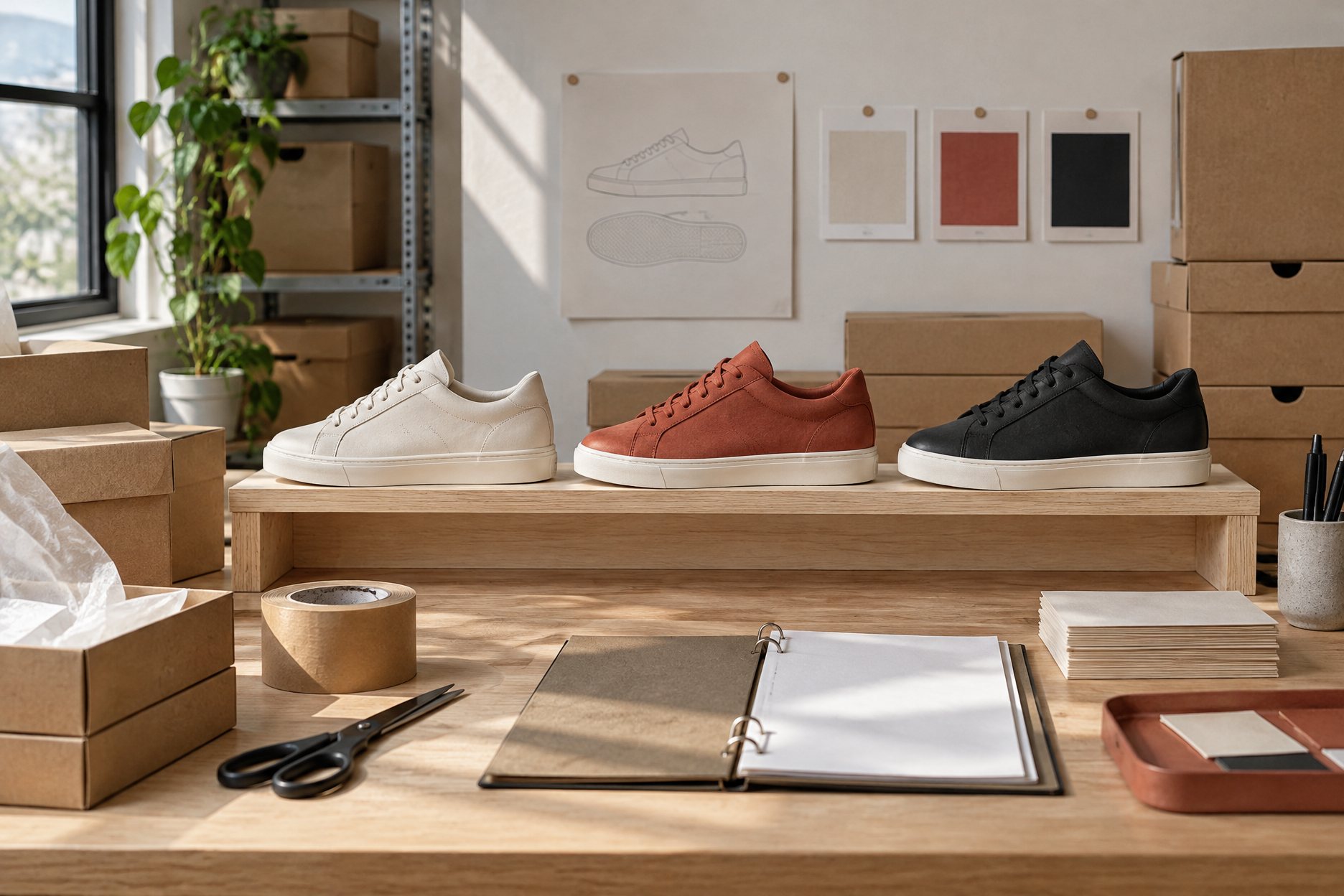
What the OEM route is for
Stock answers one question: what can I sell next month. OEM answers a different one: what is my brand. On this route the shoes do not exist yet. Your design - a sketch, a construction reference, a brief describing upper, sole and colors - becomes a spec sheet, the spec sheet becomes samples, and the approved sample becomes bulk production. The route is slower than buying cartons off a warehouse list, and it exists for buyers who need more than any list can give: an own silhouette, specific materials, a color story, branding on the box as well as the shoe.
The desk runs OEM programs with partner factories in the Jinjiang, Quanzhou cluster, matched to the construction your design calls for - cemented running platforms, vulcanized canvas builds, casual leather lines. We coordinate the development work, and we put every figure in writing before bulk starts. This page walks the route end to end: design to spec sheet, samples, tooling, labels, and the clock for each stage.
From your design to a spec sheet
Every OEM program starts with a document, not a conversation. The spec sheet turns your design into terms a factory can quote and produce against: upper materials and their placement, construction type, midsole and outsole specification, size range and grading, colors per style, packing configuration, label and packaging detail. Where a figure is not yet decided - the exact collar width, the density of a foam - the sheet says so, and the sample answers it.
You do not need a technical drawing to start. A workable brief names the style family, the target wearer, the size range your market buys, and any materials you insist on. From that, the desk drafts the sheet, the factory's development team marks what is feasible at what effort, and the two versions converge. Read what goes into a spec sheet before your first program - buyers who arrive with half the sheet already answered sample faster.
Development sample and counter-sample
Sampling is where a design stops being an idea. The first development sample executes the spec in real materials, so you can judge proportion, materials and construction on a real shoe rather than a render. Your feedback comes back as corrections, and the factory answers with a counter-sample that shows the fixes. Typically this loop - development sample plus counter-sample - takes about 15-30 days. The range is a reference, not a promise: a design sitting on an existing platform samples faster than one that needs new tooling, and the desk confirms your program's sampling schedule in writing.
Two habits keep sampling short. First, consolidate feedback: one written list of corrections per round beats a week of scattered notes. Second, approve against the spec sheet in writing, not against a memory of a conversation. The approved sample becomes the reference the bulk is inspected against, which is why the sampling process deserves more attention than most first-time buyers give it.
Platform reuse keeps minimums workable
The biggest lever on an OEM program is not negotiation - it is design. A new upper built on an existing outsole and midsole platform skips the heaviest development cost, because the molds already exist and the line is already timed. Most first programs should start there: one construction, one or two colors, a size run matched to how your channel sells. When the style proves itself, the next design can go deeper - a sculpted new sole, more colors, full custom packaging - on the strength of what the first program taught you.
This is also how smaller programs stay possible. The partner states that it executes large orders and customizes small orders flexibly, and in practice the platform decision is what makes a small program sensible: reusing tooling lowers the quantity a style needs to be worth running. Minimums are still set per style and per construction and confirmed per program in writing - there is no universal number, and a desk that quotes one without seeing your design is guessing. Read how stock and OEM minimums differ before planning your first style.
Tooling and molds
When a design does need new tooling - a sculpted outsole, a custom midsole mold - the program carries one more decision that should be settled early: which party holds the molds, and on what terms. Tooling scope, ownership and reuse across future orders are all writable into the program sheet, and they should be settled before development starts rather than after bulk. The desk puts these terms in writing per program. For the questions to ask, see tooling and molds: cost and ownership.
Labels and packaging from the start
OEM is the route where branding costs little in effort and a lot to retrofit. Woven labels, printed sockliners, hang tags, printed shoe boxes and carton marking are all decided at spec-sheet stage and carried through sampling, so the first sample you hold already looks like your product. Buyers who add custom packaging late pay for a second sample round; buyers who specify it from the start see it in round one. The desk coordinates the full branding set - see private label for what each element involves and who supplies what.
The clock, end to end
Put the stages together and the OEM clock reads like this: spec sheet agreed, development sample and counter-sample typically about 15-30 days, then bulk typically about 45-60 days after sample approval - longer before peak season, when lines fill and materials queue. Minimums per style are confirmed per program. Every one of those figures is a reference range: your program's dates are confirmed in writing against your design, your construction and your season. The full table, with the stock route beside it, is on the MOQ and lead time page.
| Stage | Typical reference range | Confirmed in writing |
|---|---|---|
| Spec sheet | Agreed before sampling starts | Materials, construction, sizes, packing, labels |
| Samples | Development + counter-sample, about 15-30 days | The approved sample becomes the bulk reference |
| Bulk | About 45-60 days after approval; longer before peak season | Quantity, inspection plan, dispatch window |
| Minimum | Set per style and tooling | Confirmed per program |
| Price | Quoted per program | From the approved spec sheet, never published |
Starting the program
Send the brief with the request form: style family, size range, quantity in pairs, target season, and any materials or branding you already know. The first reply names the route, the platform options, a sampling plan and the questions still open - so your next decision is a design decision, not a guess. If the idea is still loose, the stock route can test demand while the OEM program develops; the desk plans both sides of that handoff.