
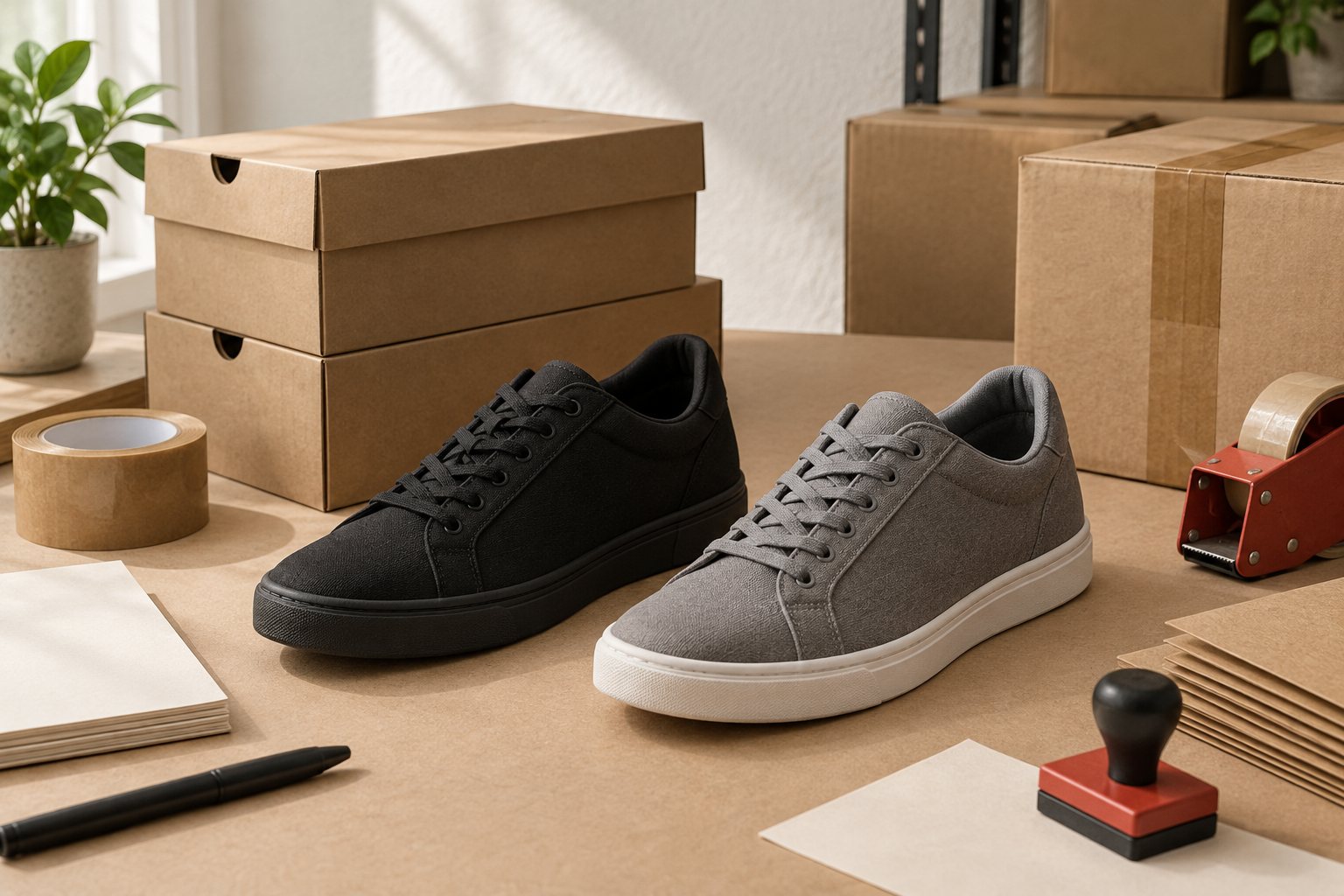
Where men's casual sneakers sit in a range
Most ranges are carried by a small set of men's builds: cushioned everyday runners, court-inspired low trainers, casual leather sneakers and, in the last few seasons, chunky lifestyle soles. These are the categories that sell across seasons and across channels, which is exactly why they are the categories a warehouse can stock in depth. If you are planning a men's range, the working questions are concrete: which builds, in which colors, in which sizes, and how many cartons. This page walks through what the desk holds in stock for men's sizes and what changes when the same category moves to OEM production.
A note on vocabulary: "men's" here is a size band, not a rule. The stock list grades by EU size, and many programs buy across the men's and women's bands from the same model codes. What decides the program is the size run you need, not the label on the shelf.
What the list carries in men's sizes
The current season's list holds 37 model codes across casual sneakers and sandals. The lots below are the sample references that run in the EU 40-45 band most men's programs buy against, with the colors and sizes exactly as they sit on the packing list. Stock moves as cartons ship, so treat this table as a picture of the style families, and confirm the live list when you send the request form.
| Style ref | Build | Colors on the list | Sizes |
|---|---|---|---|
| 3389 | Cushioned everyday runner | black; black/white; dark grey/black/light grey; light grey | EU 40-45 |
| 3316 | Court-inspired trainer | black; black/white; dark grey; off-white/light grey | EU 40-45 |
| S3286 | Low casual leather sneaker | black; dark brown; light brown | EU 40-45 |
| 3186 | Chunky lifestyle runner | black/dark grey; black/white; dark grey/grey; brown | EU 40-45 |
Three things stand out on that list, and they matter for planning. First, the colors are core: black, white, greys and browns that move across seasons without betting on a trend. Second, every lot packs 12 pairs per carton in a full size run, so one carton is a complete slice of a size curve, not a random assortment. Third, the builds span the four families a men's range usually needs - cushioned, court, leather casual and chunky - which is what makes mixed cartons practical for a first order.
How these builds are made
All four families share the same production backbone. Uppers are cut and stitched from engineered mesh, knit, PU leather, split leather or suede, depending on the style. The build itself is cemented construction: the upper is lasted over an EVA or foam midsole, the outsole is glued and pressed, and the pair moves through lasting, sole attaching and pressing before cleaning, lace setting and pair matching. Quality control at the line covers visual inspection, bond strength sampling and size conformity, and cartons leave with the model, color, size run and piece count marked. The full sequence is documented in the production process page.
The material mix is where the families diverge. The cushioned runner leans on mesh or knit uppers for breathability. The court-inspired trainer uses smoother PU or leather-look panels that wipe clean and photograph well for online listings. The leather casual (S3286) is a split leather build in black and browns - the shoe a buyer reaches for when the range needs something that reads more dressed than sport. The differences are described in detail in the materials guide, and the exact material stack for any model is confirmed on its spec sheet before you commit.
Size runs, cartons and dispatch
Men's stock runs typically step EU 40 to 45, shown per color on the list. Each carton carries 12 pairs in a size run that typically steps 1-2-3-3-2-1 across the six size steps - more pairs in the middle sizes, fewer at the ends, which mirrors how shoes actually sell through. Mixed models are allowed within a carton, so a first order can spread across two or three of the lots above instead of committing twelve pairs to one build. Cartons measure about 70-77 x 41.5-45.5 x 32.5-34.5 cm, small enough to plan storage and freight against real numbers. Confirmed orders are picked immediately from the partner's spot warehouse and typically dispatch within days; the exact size run, carton count and dispatch date for your program are confirmed in writing. How buyers structure first orders is covered in the lot buying guide, and the size curve itself is explained in the size chart.
Stock or OEM for this category
The stock route answers "what can I sell next month": proven men's builds, core colors, no tooling, dispatch in days. The OEM route answers "what is my brand": your upper design developed on a platform, your labels and boxes from the first sample, produced in about 45-60 days after approval. The two connect directly. A buyer who tests the 3389 or 3316 in stock learns which of the four families their channel actually sells - and the winner converts to an OEM program the following season with the brand's own branding, on the same sole platform, so the tooling risk stays low. Typical OEM reference ranges: development and counter-samples about 15-30 days, bulk about 45-60 days after sample approval, always confirmed in writing per program in MOQ and lead time.
- Brief. Name the families you want, the size run, the quantity in cartons or pairs and your target date on the request form.
- List or spec. Stock buyers get the live list with colors and runs; OEM buyers get a spec sheet with materials, construction and packing.
- Sample or pick. Stock can start from cartons directly; OEM runs development and counter-samples first.
- Confirm and ship. Quantities, packing, marking and inspection are set in writing before cartons seal.
One line applies to every men's program, stock or OEM: the desk coordinates original generic designs only, and never quotes styles that copy third-party brands. It is the sentence that keeps a fast order from becoming a customs problem later.