
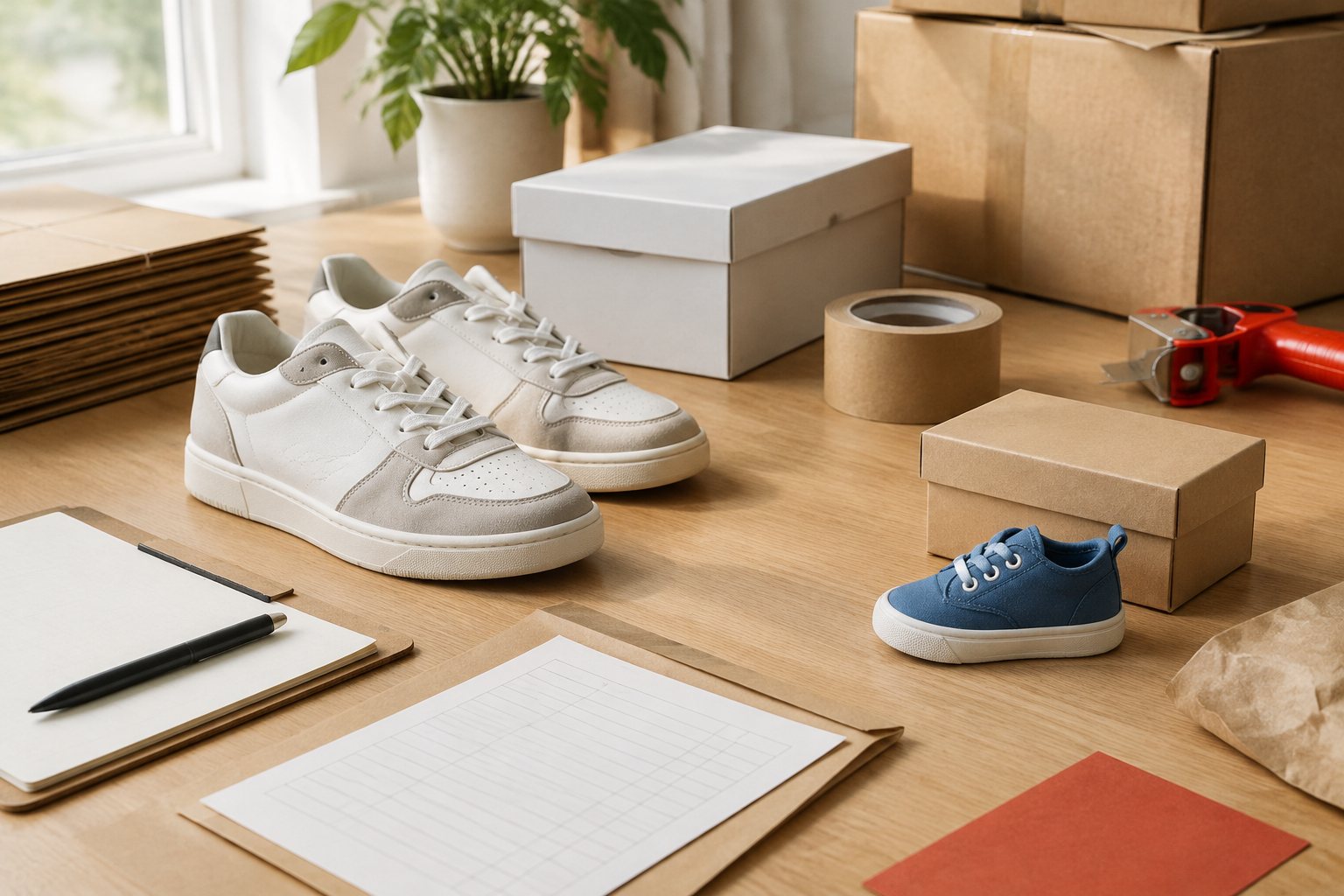
What kids' programs actually buy
Kids' sneaker programs come from two buyer types, and they buy differently. Online and marketplace sellers want the chunky, colorful builds that photograph well and sell on trend cycles - the kids' chunky sneaker is the category engine. Schools, uniform programs and chain-store buyers want plainer, harder-wearing casual builds in stable size runs, ordered against enrollment rather than fashion. Both buy in the band the stock list covers - EU 36-41, which is the older-kid range - and both need the same thing the adult categories need, plus one more layer: children's product compliance. This page covers the lot on the list, the compliance layer, and how stock and OEM split the work.
A sizing note first, because kids' sizing is where assumptions cause the most damage. The stock list grades by EU size, 36-41 on the kids' runs. Age does not map to size reliably enough to order from, so the desk never quotes "age 8 = size 30" style claims; the age-to-size expectation for your program is set on the spec sheet, and the fit questions are covered in the kids' sizing guide.
The kids' lot on the list
The sample lot below is the kids' reference in the current season: a chunky sneaker in five colorways, EU 36-41, packed 12 pairs per carton. The live list at RFQ confirms what is on hand that week, in every color and size run.
| Style ref | Build | Colors on the list | Sizes |
|---|---|---|---|
| CH7-1 | Kids' chunky sneaker | black; white/mint/white; white/pink/magenta; white/blue; black/pink | EU 36-41 |
The color spread on that lot is deliberate. Kids' channels sell color in a way adult core ranges do not - mint, pink, magenta and blue alongside black and white - and five colorways in one build let a buyer spread a carton plan across the palette instead of guessing one winner. Twelve pairs per carton with mixed models allowed keeps the first order small; the kids' category is one where a season of sell-through data is worth more than any forecast.
Compliance comes first for kids
Children's footwear sold in the United States falls under CPSIA, and the requirements are concrete: third-party testing at a CPSC-accepted lab, a Children's Product Certificate, and tracking labels on the product. Small decorative parts and trims - the eyelets, charms and appliques kids' styles often carry - are assessed for lead and small-parts hazards. None of this is optional, and none of it is something a buyer should discover after the cartons land. The desk arranges the testing and certificate path per program through the partner factories, and confirms the plan in writing before bulk. The detail is set out on the compliance page and in the CPSIA note for kids' shoes; general information there, with your compliance adviser making the final call for your market.
Two practical consequences follow. First, for OEM kids' programs, trims and decorations are reviewed at the development stage, before they exist in bulk, because changing a charm after tooling is expensive. Second, a stock program for US kids' channels is confirmed only with the testing and certificate path attached - the desk will not ship kids' stock into the US on an assumption. Both lines are in writing on the program sheet.
Construction notes
Kids' builds use the same production backbone as the adult casuals: uppers cut and stitched from mesh, knit or PU, cemented construction over an EVA or foam midsole, outsole glued and pressed, then lasting, QC and packing. The differences are proportional rather than structural - lighter sole units, easier entry, and color applications that adult styles skip. What deserves a buyer's attention is durability at the wear points: toe caps, heel counters and the bond line, which is why bond strength sampling is part of the line QC the desk checks. For US-bound kids' programs, every decorative trim is also a compliance item, which is the one construction choice that can genuinely change a kids' program's shape.
Reorder discipline matters more in kids' programs than in most, for a reason specific to the category: the wearers grow out of sizes on a schedule no sales chart shows. A size that sells through in eight weeks may be gone from your customer base by next season, so depth bought late in the year is depth bought for the wrong feet. The desk's working advice is to reorder against sell-through speed early in the season and to taper the band from the small sizes up as the year runs.
Carton math in the kids' band differs from adult buying in one respect worth planning around. The 36-41 band spans six steps, and the 1-2-3-3-2-1 run concentrates pairs in the middle - which is not where a kids' channel sells evenly, because the younger half of the band usually turns over faster than the older half. The desk handles uneven demand the same way it does on adult categories: mixed cartons across models, plus a run weighted toward the smaller steps for programs where the sales data shows it. Both are confirmed in writing on the program sheet; neither is an assumption.
Stock or OEM for kids' programs
Stock suits the seller who needs the chunky color story this season: CH7-1 in five colorways, picked on confirmation, typically dispatching within days, minimums counted in cartons. OEM suits the school, uniform or brand buyer: a plain, hard-wearing kids' build developed to a spec sheet, with sizes set by age band for the enrollment you are actually dressing, and testing built into development. Reference ranges for OEM planning: samples about 15-30 days, bulk about 45-60 days after approval, confirmed in writing per program. Send the brief through the request form and the desk will name the route, the testing plan and the open questions in the first reply. For how school programs structure orders, see the school program notes, and for the build families across ages, the kids' types overview.