
The working chart, EU 36-45
The stock list grades in EU sizes, from 36 to 45, with some women's and kids' runs covering 36-41. Buyers selling into US channels need that band translated, and the table below is the desk's working reference. Read it as approximate - it is a conversion, not a law. Brands grade differently, and the final size grading for any program is confirmed on the spec sheet before cartons are packed.
| EU | US Men | US Women | Foot length (cm, approx) |
|---|---|---|---|
| 36 | 4 | 5.5-6 | 22.5-23 |
| 37 | 4.5-5 | 6-6.5 | 23-23.5 |
| 38 | 5.5-6 | 7-7.5 | 24-24.5 |
| 39 | 6.5-7 | 8-8.5 | 24.5-25 |
| 40 | 7-7.5 | 8.5-9 | 25-25.5 |
| 41 | 8-8.5 | 9.5-10 | 26-26.5 |
| 42 | 8.5-9 | 10-10.5 | 26.5-27 |
| 43 | 9.5-10 | 11 | 27.5-28 |
| 44 | 10-10.5 | 11.5-12 | 28-28.5 |
| 45 | 11-11.5 | 12.5-13 | 29-29.5 |
Three readings of that table matter for a buying decision. The US Men and US Women columns differ by roughly the offset you would expect, but the women's column is wider at the small end - a US women's 5.5-6 all maps to EU 36, which is why a women's program in the 36-41 band covers most of a US women's size curve. The foot length column is the honest anchor: when a conversion argument breaks out, measuring the foot ends it. And the whole chart stops at 45 - buyers whose channels need 46 or larger are asking an OEM grading question, not a stock question.
How to measure a foot so the chart works
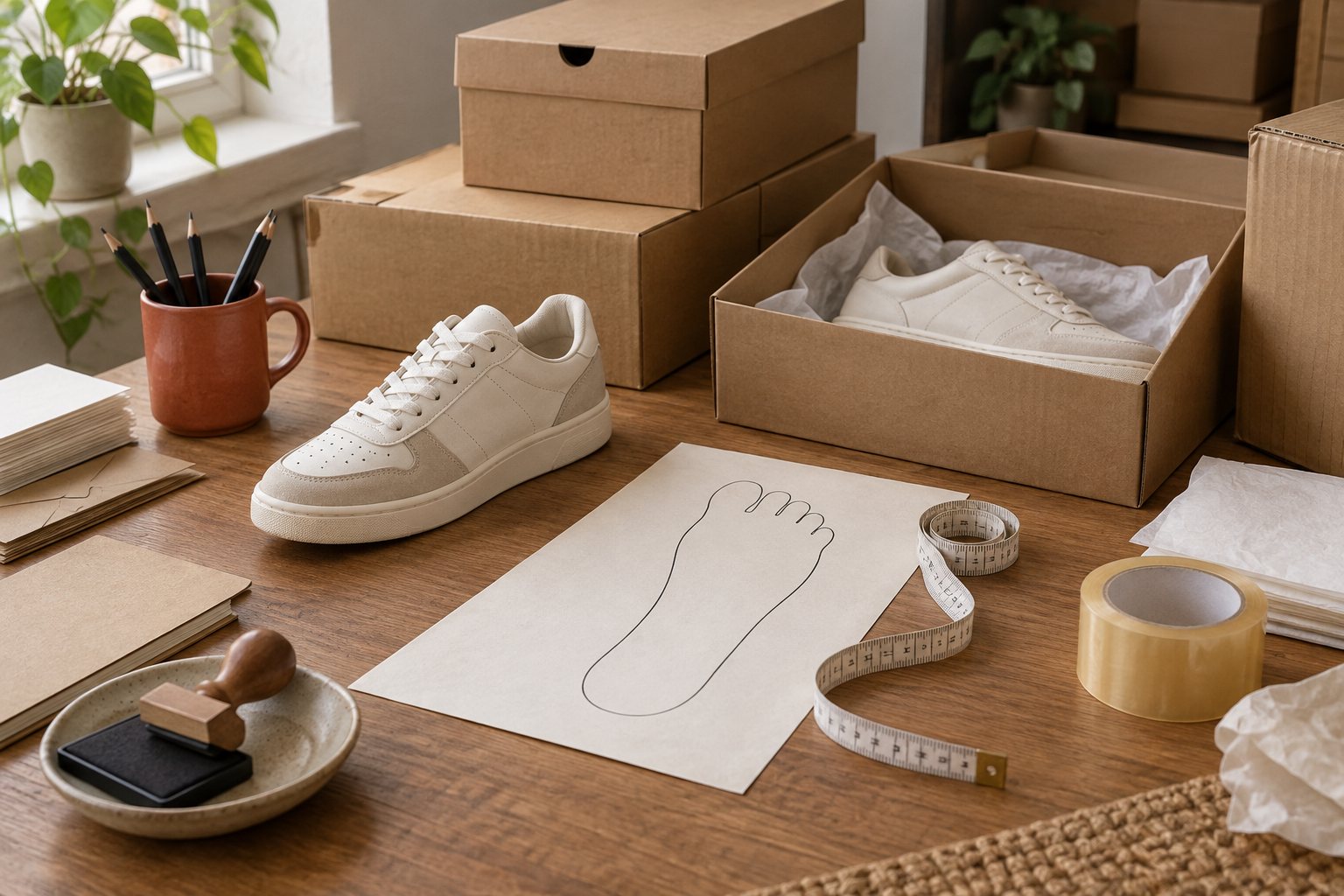
The foot length column assumes one measurement method, and it is worth spelling out because half of the size complaints a seller receives trace back to it. Stand the wearer on a sheet of paper against a wall, heel touching. Mark the tip of the longest toe - which is not always the big toe. Measure from the wall edge to the mark, heel to longest toe, with the person standing, not seated, because the foot lengthens under load. That number, in centimeters, is what the right-hand column converts. Measure both feet and fit to the longer one. The method is described step by step, with the sizing pitfalls around it, in the measuring guide, and the way these charts are built in the first place in the size charts explainer.
What the method deliberately excludes is width. The chart is a length chart; a foot that is wide for its length needs a fit conversation, not a bigger size, and the exchange-rate problem that follows - sizing up to gain width and losing length fit - is covered in the wide-feet note.
How size runs work in a carton
Stock cartons do not carry one size; they carry a run. A carton of 12 pairs typically steps 1-2-3-3-2-1 across the six size steps of the run - one pair at each end of the band, two in the second and fifth steps, three in the two middle steps. The shape copies the demand curve: middle sizes sell hardest, extremes slowest. Two consequences follow for a buyer planning a program.
- Cartons are slices of a curve, not choices of size. A program's size profile is set by how many cartons it buys, not by picking sizes pair by pair. That is why the desk asks for your sales data before confirming runs - the run has to match how your channel actually sells.
- The band matters as much as the depth. A run at EU 40-45 and a run at 36-41 are different products. The 36-41 band serves women's and older-kid programs; the 40-45 band serves men's. The conversion table above is how you check which band your market needs before the cartons are picked.
The packing detail behind runs - how the pairs sit in the carton, how the carton is marked with model, color, size run and pieces - is part of the standard the partner's warehouse packs to, and it is what makes mixed-carton orders possible for small buyers. The buying logic around this is in the lot buying guide, and the fuller conversion discussion for US-bound programs in the conversion note for bulk buyers. Kids' sizing, where age is a poor proxy for size, has its own treatment in the kids' sizing guide.
If the chart and your sales data disagree, trust your data - and tell the desk. Size runs are confirmed per program in writing, and a run adjusted to a real sales curve is the single most valuable upgrade a footwear program can get. Bring both to the request form and the program gets quoted against the numbers that matter.
What the chart does not cover
Three limits belong next to any size chart, and sellers who state them up front get fewer returns. Width: the chart measures length only, and a foot wide for its length needs a different last, not a bigger size. Half sizes: the stock bands step in whole EU sizes; where a channel needs half-size grading, that is an OEM spec item to be set on the last, not a stock option to be requested. And brand variance: the same foot can wear two adjacent EU sizes across two factories, which is why the desk anchors programs to foot length and the spec sheet rather than to the conversion columns alone. A product page that carries the chart, the measurement method and those three caveats answers most size questions before they become support tickets.
Size runs at the edges of the band
One more run detail matters at the extremes. Because each end of the 1-2-3-3-2-1 curve carries a single pair per carton, the smallest and largest steps are the slowest to replace once sold. A channel that regularly sells the end steps should say so in the brief, since a run can be weighted toward the ends for programs where the data supports it - runs are confirmed per program in writing, and adjusted runs are quoted as adjusted, never assumed.