
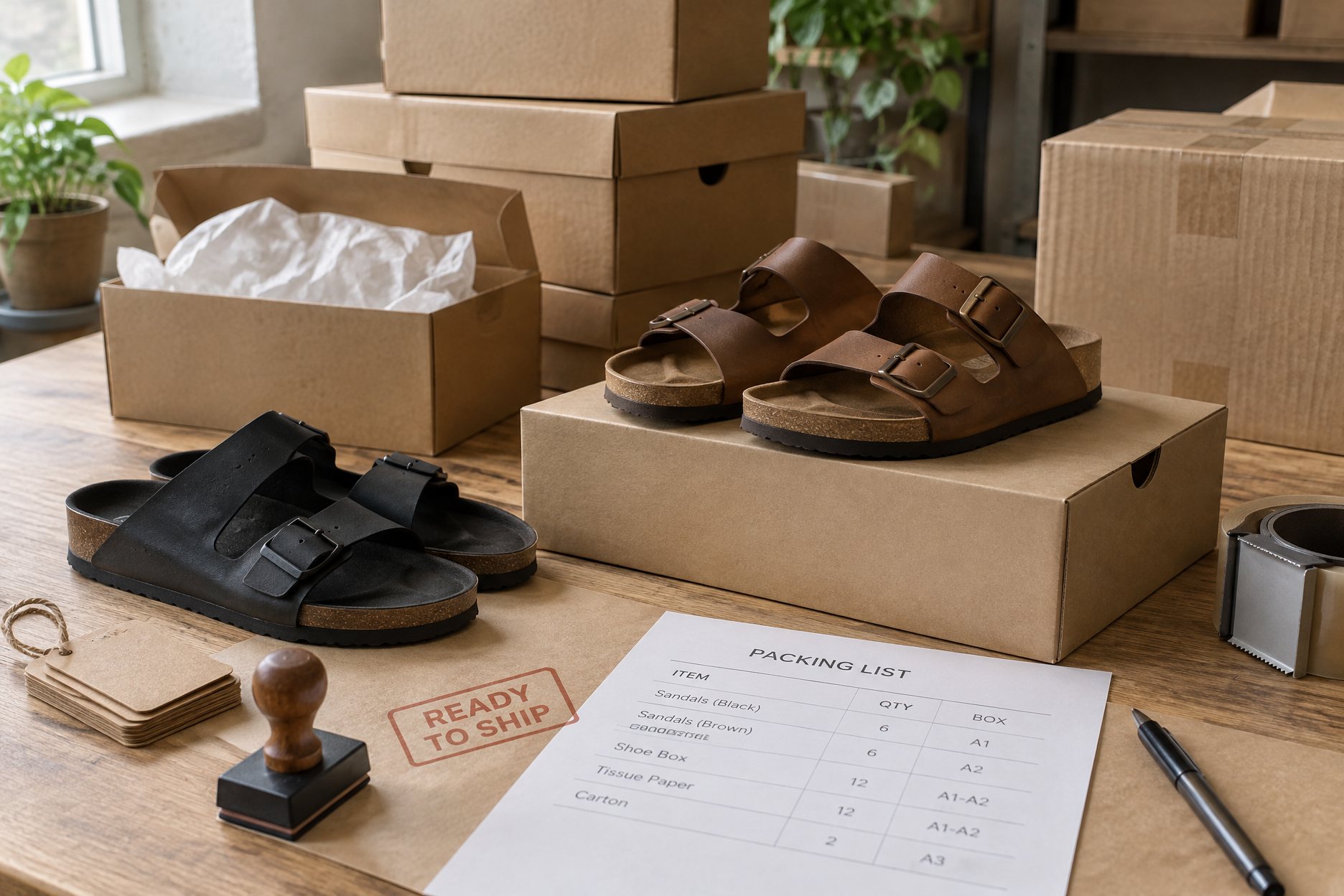
Why sandals sit in the sneaker program
Footwear buyers treat sandals as a second category, but the warehouse does not: the same Jinjiang partner runs sandal lines alongside its casual sneaker lines, and the current stock list holds 37 model codes across casual sneakers and sandals. That matters commercially, because warm-season demand arrives on a clock that sneaker buyers do not feel - a sandal program ordered too late ships into the end of its own season. The stock route answers that clock the same way it does for sneakers: finished goods, picked on confirmation, typically dispatching within days. This page covers what the sandal categories are, how they are built, and how to time a program against the season.
A vocabulary note first. The taxonomy the desk uses names the category as two-strap sandals with EVA or PU footbeds - the adjustable casual sandal that dominates volume in this class. Buyers usually call the open-heel, single-band variants slides; where the live list carries those, they are quoted the same way, by the carton, from the same warehouse. Single-strap, three-strap or footbed-specific variants are confirmed from the live list rather than promised in general.
What the categories look like
Two-strap sandals are the workhorse: two adjustable bands across the instep, a contoured footbed in EVA or PU, and a rubber or EVA-blend outsole. The construction is simpler than a sneaker's - no lasting board complexity, fewer upper panels - which is why sandal programs can be quoted tightly and why the category tolerates mixed cartons well. Footbed sandals trade the plain bed for a shaped, often contoured surface and lean on comfort positioning; their footbed material (EVA for the lighter builds, PU for the denser, more leather-look builds) is a spec-sheet item that changes both the feel and the labeling of the shoe. The material vocabulary - EVA, PU, rubber outsoles - is the same one used across the sneaker range and is set out in the materials guide.
Sizes follow the list pattern: EU 36-45 across the program, with some runs at 36-41, and 12 pairs per carton in a size run shown per color, typically stepping 1-2-3-3-2-1 across the six size steps. Mixed models are allowed within a carton, which makes sandals a practical second line for a sneaker buyer: a carton each of two sandal styles alongside a sneaker order tests the warm-season line without a separate program.
The two-strap build, element by element
The category is simple enough that its whole spec fits in one table, which is part of its appeal for buyers adding a second line.
| Element | Typical spec | Buyer note |
|---|---|---|
| Straps | Two bands across the instep, PU or textile, adjustable | Closure type and strap width are spec-sheet items; wider bands read more casual |
| Footbed | Contoured EVA or PU | EVA reads light and sporty; PU reads denser and more dressed |
| Outsole | Rubber or EVA-blend | A grip pattern matters for poolside, beach and boat-deck channels |
| Marking and packing | Model, color, size run, pieces per carton | Same carton standard as the sneaker program, 12 pairs |
One honest limitation belongs in the listing copy: straps adjust across the instep, but length is fixed, so the size chart does the work a lace would. Buyers converting sandal listings for US channels should read the conversion table in the size chart with extra care at the band edges, where open-toe sizing complaints concentrate.
Timing is the real spec
Sandal demand is seasonal, and the season punishes lateness twice: late orders miss the sell-through window, and early-season OEM slots are the ones factories commit first. The desk's standing advice runs in two parts. On stock, order early in the season and let the warehouse depth carry the peak - confirmed orders are picked immediately and typically dispatch within days, so the constraint is the list, not the calendar. On OEM, work backward from your retail window: samples about 15-30 days, bulk about 45-60 days after approval, longer before peak season - reference ranges, confirmed in writing per program. The timing logic is laid out in the season planning note.
One more stock-specific note: sandals are forgiving in a warehouse in a way sneakers are not - no midsole compression concerns in the same way - but they are not timeless. Footbed surfaces, strap elastics and colorways age, and long-held inventory shows it. How stock ages and what to check before reordering deep is covered in the shelf life note.
The sell-through math is short and unforgiving: a sandal program that lands four weeks late loses a quarter of its selling window, and depth bought into the tail of the season becomes next year's aging stock. Buyers running both sneakers and sandals should treat the sandal calendar as the earlier of the two deadlines and let the sneaker program follow it, since sneakers sell twelve months a year and sandals do not.
How to brief a sandal program
The brief the desk needs is short: the category (two-strap, footbed, or whatever the live list carries), the size band, carton counts, and the date your channel needs to be selling. Send it through the request form and the reply comes back with the live sandal codes, colors, size runs and cartons on hand, in writing, plus an OEM option where the stock list cannot cover the spec. Sandals are the easiest second category a sneaker buyer can add - same warehouse, same packing, same paperwork - which is exactly why the desk keeps them in the same program. The route mechanics behind both options sit on MOQ and lead time.