
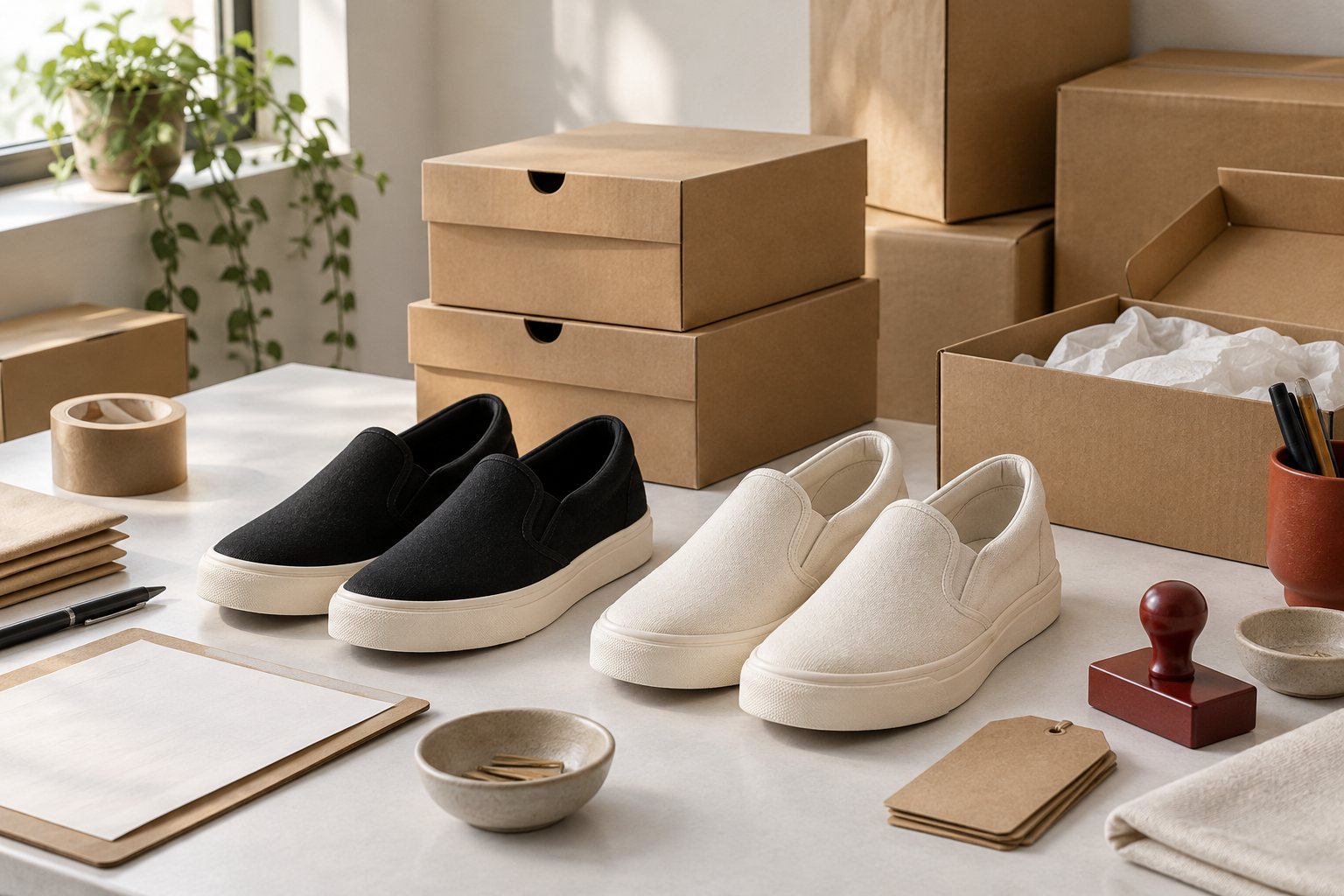
One change, everything follows
Remove the lace row from a casual sneaker and three things change at once. The opening has to hold its shape without a lace to cinch it, which is what the elastic gores on either side of the throat do - they stretch for entry and recover to grip the instep. The heel has to do the work the laces no longer do, which is why heel counters matter more in this category than any other casual build. And the upper pattern changes structurally: a single-piece vamp or a zippered front replaces the separated eyestay panels, which alters how the upper is cut, stitched and reinforced. A slip-on is therefore not "a sneaker minus laces" but its own construction, and buyers who spec it like a lace-up get returns at the heel.
The commercial case is just as concrete. Slip-ons serve the convenience buyer - easy on, easy off - and the categories that care most are travel, hospital and hospitality uniforms, older-buyer programs and kids' ranges where laces are a daily problem. The desk's older-buyer note covers that end of the market in the easy-on article, and the category's construction in depth in the slip-on guide.
Construction notes for buyers
Four elements decide whether a slip-on program succeeds, and all four are spec-sheet items rather than factory defaults.
| Element | What it does | Set where |
|---|---|---|
| Elastic gores | Stretch for entry, recover to hold the instep; width and tension set the fit | Spec sheet per program |
| Heel counter | Keeps the heel from collapsing now that laces do not pull it snug | Spec sheet per program |
| Upper pattern | One-piece or zip-front vamp, reinforced at the gore seams | Development sample |
| Sole build | Cemented over a foam midsole, or vulcanized with a rubber foxing | Spec sheet per program |
Two of those deserve a paragraph. The gores are the wear item: elastic that is wrong for the application relaxes early, and the shoe turns from convenient to loose within a season of hard wear. Gore elastic quality is a material choice confirmed on the spec sheet and checked through the same line QC - visual inspection, bond strength sampling, size conformity - that the desk runs on every program. The vulcanized option is the other fork: canvas uppers with a rubber foxing, oven-cured, give the category its flatter, more classic look, while cemented builds over a foam midsole give it a cushioned, modern one. The two constructions are compared in the construction comparison.
Where the category sells
Slip-ons concentrate in channels where the laces are the problem, not the style. Travel retail, where security checkpoints turned easy-on into a product requirement. Hospital and hospitality uniform programs, where the shoe goes on and off across shifts and lace hygiene is a standing complaint. Older-buyer assortments, where reduced bending is the reason for the purchase. And kids' channels, where laces are a daily failure point until tying is learned. Each channel pulls the spec slightly differently - the uniform buyer wants wipe-clean uppers and a stable white, the travel buyer wants light weight and packability, the kids' buyer wants a gore strong enough to survive being stomped into. Naming the channel in the brief is therefore not background information; it selects the spec.
Sizing and fit behavior
Slip-ons fit differently from lace-ups at the same size, for the obvious reason: a lace-up adjusts, a slip-on does not. Buyers should expect the fit conversation to happen at the gore and the instep rather than the toe, and should sample before committing a size run. The stock list grades EU 36-45 across the range with some runs at 36-41, and cartons pack 12 pairs in the typical 1-2-3-3-2-1 run - see the size chart for the EU-to-US conversion, labeled approximate, with final grading confirmed on the spec sheet per program. For channels serving older buyers, one half-size of extra room is a fit decision to make deliberately, not an accident of the run.
Stock or OEM for slip-ons
Briefing a slip-on program
- Name the channel. Uniform, travel, kids or lifestyle - it sets the upper and the sole.
- Pick the construction. Vulcanized canvas for the flat classic look, cemented foam for the cushioned modern one.
- Spec the fit points. Gore width and tension, heel counter firmness, instep height.
- Sample, then size. Counter-sample first, because slip-on fit is fixed; then confirm the run against the chart.
- Confirm in writing. Materials, labeling, packing and dates on the program sheet before bulk.
The desk's role across those steps is the same as on any category: translate the brief into a spec the factory can quote against, manage the samples, and check the bulk against the approved reference before cartons seal.
Stock or OEM for slip-ons
The current sample lots do not include a slip-on - the warehouse skews to lace-up casuals, chunky builds and sandals - so the honest answer on stock is: ask. The live list behind the stock page holds 37 model codes across casual sneakers and sandals and changes as cartons ship, and what is on hand that week is confirmed at RFQ. For a slip-on built to your spec - gore width, heel structure, canvas or knit upper, your labels - OEM is the dependable route. Development and counter-samples typically run about 15-30 days, bulk about 45-60 days after approval, longer before peak season; reference ranges, confirmed in writing per program. Send the brief through the request form and name the channel the shoe serves - the fit decisions follow from it.