
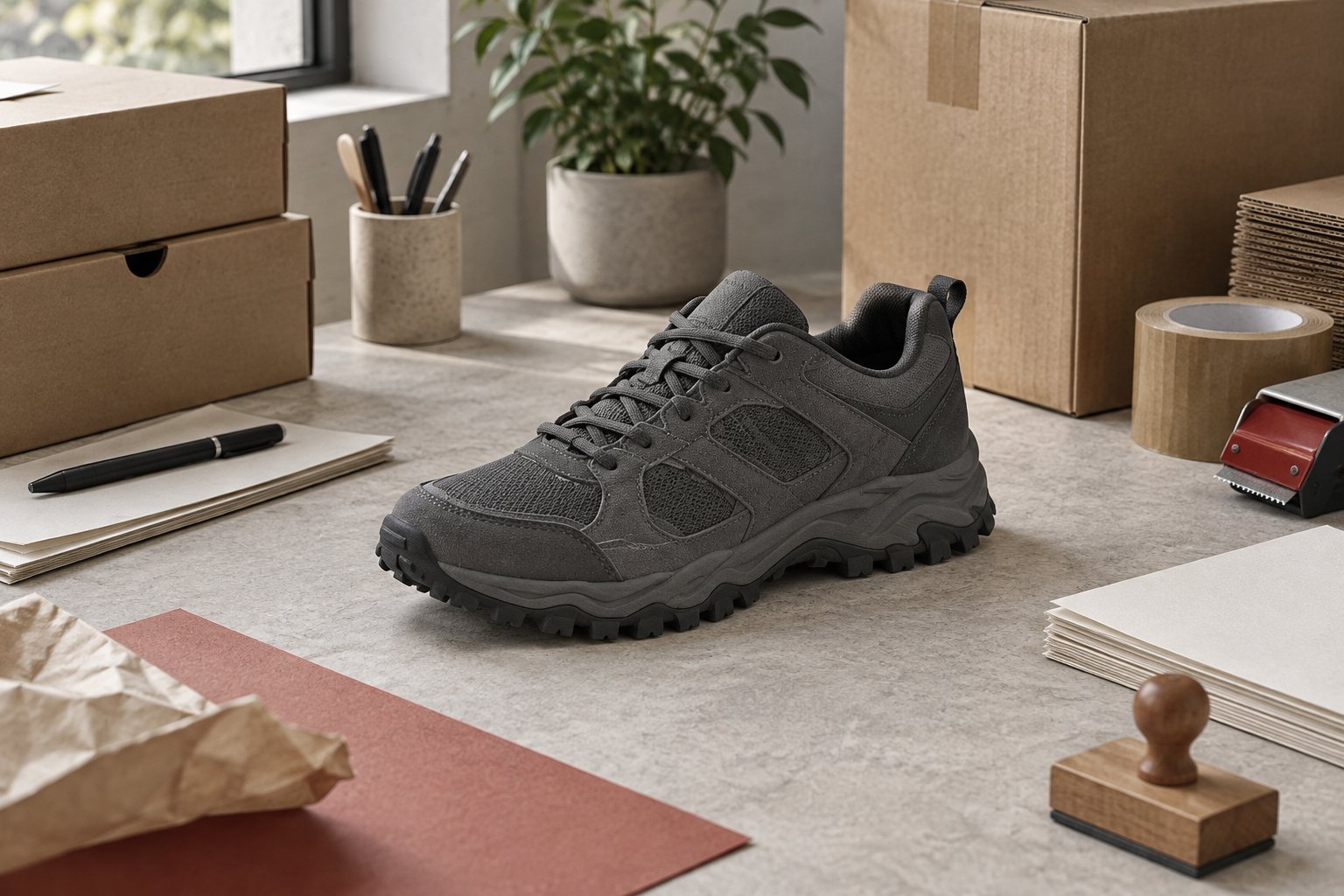
What "trail-style" means on a casual sneaker
Trail-style sneakers are casual builds that borrow the visible, functional vocabulary of outdoor footwear. Three features define the category, and all three are things a buyer can verify on the sample in hand. First, the outsole: a grip-pattern rubber sole with deeper lugs and more edge bite than a flat court or runner sole, designed for loose and uneven surfaces. Second, the toe guard: a reinforced cap or overlay over the front of the shoe, because trail use punishes toe boxes against roots and rock edges. Third, the upper: tougher panels - denser mesh, PU or suede reinforcements - laid over the wear points rather than a single light textile. None of that turns a casual sneaker into a technical mountain shoe, and the desk never claims it does; the category's honest description is a rugged everyday shoe with outdoor manners, and that is exactly the position it fills in a range.
For a range planner the category earns its slot the same way chunky builds do: by looking different for a structural reason. Next to court lows and slim retro runners, a trail-style shoe reads as utility - and utility sells across seasons without trend support.
The trail lot on the list
The current list carries a trail-style runner in five colorways at EU 36-41, packed 12 pairs per carton. Colors and sizes are shown exactly as the packing list states them; stock changes as cartons ship, so the live list at RFQ is the document that counts.
| Style ref | Build | Colors on the list | Sizes |
|---|---|---|---|
| CH26 | Trail-style runner | black/white; light grey/black/green; grey/blue/black; white/grey; white/orange/black | EU 36-41 |
Two planning notes on that row. The color plan mixes core builds (black, grey) with outdoor-toned accents (green, orange), which suits a category that trades on utility looks. And the size band - EU 36-41 - makes the lot a fit for women's and older-kid programs as much as men's; buyers targeting the 40-45 band should say so in the brief so the desk can check the live list or quote an OEM platform in that grading. Exact runs and carton counts are confirmed in writing when you send the request form.
Positioning the category in a range
Trail-style builds earn a specific slot in a range plan, and it is worth naming it precisely. They are the utility anchor: the build that makes the rest of the line look considered by contrast, the way a work jacket steadies a rack of tees. They pull a men's and women's buy together - the silhouette reads unisex in a way court lows do not - which is why the 36-41 band on the stocked lot matters more than it looks: one style, two buyer groups. And they resist discounting better than fashion-led builds, because the buyer's justification is function rather than novelty. The corresponding risk is overclaiming: a trail-style casual marketed as technical equipment invites exactly the returns and reviews that an honest description avoids. Keep the copy on grip, protection and materials, and the category holds its slot without borrowing credibility it does not have.
Construction notes
The build follows the standard cemented flow: upper cut and stitched, lasted over a foam midsole, rubber outsole glued and pressed, then lasting checks, QC and packing. What differs is emphasis. The outsole compound and lug pattern are chosen for grip rather than a flat, clean footprint, and the pattern is a spec-sheet item on OEM programs - buyers who care about the difference between pavement wear and loose-surface grip should read the outsole comparison in the outsole note. The toe guard and the reinforced overlays are stitched structural elements, not glued trims, which is how they survive the use they are sold for. And because the category leans on textile uppers, the mesh choice matters; the trade-offs are set out in the mesh uppers note and the material stack in the materials guide.
One expectation to set with your customers, not with the desk: stock trail-style sneakers are not waterproof-labeled footwear. Water resistance claims belong to specific constructions and membranes, and the desk treats them as OEM spec items to be verified by test report rather than adjectives to be added to a listing. The honest framing for a trail-style casual is grip, protection and a rugged upper - described in the trail-style guide.
The checks that matter at inspection follow from those three features. Outsole: lug edges clean-cut, no flash lines along the grip pattern, a bond line that runs continuous where the sole meets the midsole. Toe guard: stitched, not just glued, with the stitching catching the base mesh rather than riding the overlay alone. Upper reinforcements: overlays anchored through the stress points, and the mesh behind them dense enough that a thumbnail press does not deform it. None of this requires a laboratory; it is the sample-table version of the QC the desk runs at the line, and a buyer who can run it on a sample carton can brief the desk precisely when something looks wrong.
Stock or OEM for trail builds
Stock answers the fast question: CH26 exists, in five colorways, picked on confirmation from the partner's spot warehouse and typically dispatching within days, minimums by the carton of 12 pairs with mixed models allowed. OEM answers the specification question: your lug pattern, your panel layout, your grading - EU 36-45 or a tighter band - your labels, developed through counter-samples typically about 15-30 days, then bulk about 45-60 days after approval, longer before peak season. Reference ranges, confirmed in writing per program. A practical sequence for a marketplace seller: test the CH26 lot to read the size curve and the color response, then move the winning direction into an OEM build with your own sole pattern the following season. Start either path on the request form; the route mechanics are compared on MOQ and lead time.